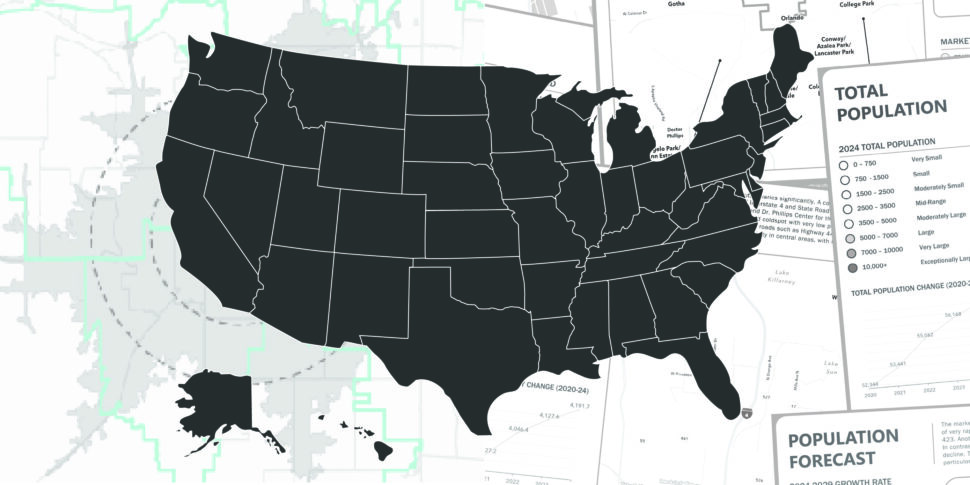
TSCG Retail Markets are purpose-built geographic districts, more than 4,400 of them nationwide, drawn around how and where people actually shop, not around postal routes or political lines. Each market follows natural retail corridors, respects census block-group boundaries, and gives analysts a single, stable frame of reference for everything from site selection to territory design.
TSCG Market Intelligence Reports deliver a powerful, data-driven understanding of over 4,400 retail markets across the United States, helping businesses make smarter, faster, and more confident location and investment decisions. Each report provides a comprehensive snapshot of key demographic and economic indicators – such as population growth, household dynamics, diversity, employment trends, and development activity – visualized through geospatial maps and proprietary analytics.
By going beyond simple census data, these reports uncover the story behind the numbers: where people are moving, how communities are evolving, and which trade areas are primed for growth. From dense urban hubs to emerging suburban corridors, TSCG’s reports translate local market shifts into strategic intelligence. Whether you’re a retailer evaluating site potential, a developer identifying high-growth corridors, an investor assessing market risk, or a municipality planning economic expansion, these reports deliver clarity and context. They highlight not just who lives in a market, but why it matters – pinpointing where opportunity meets demand.
What’s Included with Retail Markets
Retail-centric boundaries for all 50 U.S. States.
What’s Included with Market Reports
Currently Included: Population
Coming Soon: Income & Education, Employment & Business, Residential Development, Consumer Segmentation, Retail Activity & Development, and Public Safety
Pricing is prorated to reflect current coverage. Full pricing will apply once all planned sections are released.
How To Use Retail Markets
These proprietary markets provide a more accurate foundation for real estate planning, retail strategy, and market evaluation. They help brands, landlords, and investors make better, data-informed decisions.
- Retailers & Franchisors – Pinpoint true white space, balance franchise territories, and prioritize growth markets objectively.
- Landlords & Developers – Benchmark assets against the real competitive set and merchandise to match each market’s shopper profile.
- Investors & Lenders – Grade centers and portfolios on apples-to-apples market metrics, revealing hidden upside (or hidden risk).
- Economic-Development Teams – Focus incentives on the Retail Markets that will move the needle for jobs, taxes, and retail.
How To Use Market Reports
Each Market Intelligence Report is designed to be both intuitive and actionable. Begin with the overview and map sections to understand market boundaries, nearby trade areas, and key traffic drivers such as major employers, universities, and shopping centers. Then, use the demographic and growth visualizations – including population density, diversity index, and forecast maps – to identify where growth is accelerating or slowing.
These insights can guide:
- Retailers in optimizing site selection and market expansion strategies.
- Commercial Developers in identifying underserved areas with untapped demand.
- Investors & Lenders in quantifying market potential and mitigating risk.
- Local Governments & Economic-Development Agencies in planning infrastructure and resource allocation.
When used across multiple markets, these reports become a national benchmarking tool – allowing stakeholders to compare markets, detect emerging trends, and align investments with long-term demographic shifts.
Download File Types Available for Retail Markets
Shapefile (SHP), KML, GeoJson